DOMINANT CYCLES
Oscillator/cycle analysis involves the isolation and use of 4 dominant cycles
- Long-term DOMINANT CYCLES that are longer than one year in length, establish the longer-term trends of the markets. Long- term cycles most markets range from 2 to 11 years.
- The SEASONAL CYCLE is the yearly cycle that tends to have highs and lows occur at approximately the same time periods of the year. It is a very distinct cycle in agricultural markets and shows up as Seasonal tendencies in most other markets, including metals and the financials. Seasonal Cycles follow reliable patterns, and their highs and lows can be anticipated with an unusually high degree of accuracy.
- The INTERMEDIATE CYCLE is the dominant weekly cycle shorter than one year. Each market has its own Primary Cycle, and the average cycle length ranges from 9 to 22 weeks. A few markets have a smaller sub-cycle called the 1/2 Intermediate Cycle which averages one-half the length of the Intermediate Cycle. The Intermediate Cycle and 1/2 Intermediate Cycle will normally top and bottom with a concurrent Daily Cycle
- The DAILY CYCLE is usually measured in days. This cycle is used to enter and exit the market for short-term trades. Most Daily Cycle lengths are from 3 to 5 weeks in the agricultures and metals; the financials tend to have Daily Cycles of approximately 8 weeks. Within the Daily cycle are two smaller sub-cycles, each normally one-half the length of the longer Daily Cycle. The Daily Cycle does not have its own crest. It will always crest at the same time as one of the shorter sub-cycles
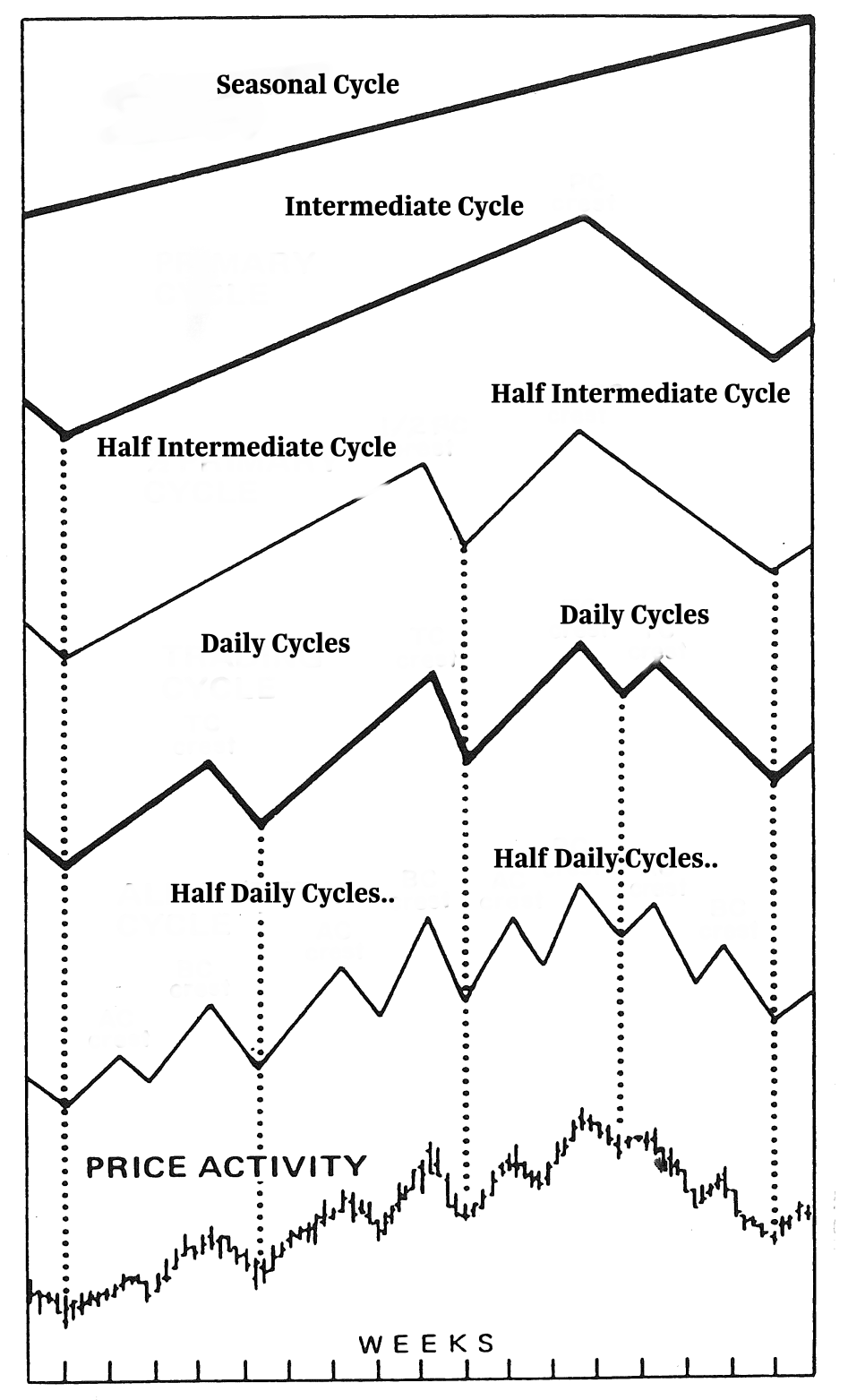 The following cyclic concepts can be applied to any two dominant cycles, one being longer than the other:
- Right Translation—Higher crests and higher troughs tend occur in a rising market as the next longer dominant cycle is moving up … as the trend is up.
- Left Translation—Lower troughs and lower crests tend to occur in a falling market as the next longer dominant cycle is moving down … as the trend is down.
- Each longer cycle determines the trend for the next shorter cycle.
- If the direction of the longer cycle is known, then the trend is known for the shorter cycle. See Right and Left Translation for more details.