Right and Left Translation
One of the many advantages of cycle analysis is that realistic expectations for time and price moves can be established. A basic understanding of the concept of Right and Left Translation provides additional input to determine your trading strategies and money management.
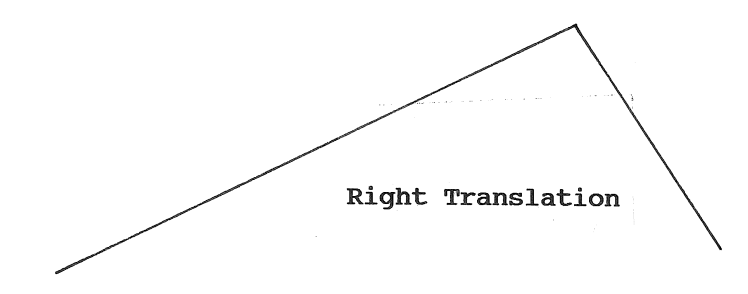
As a market is rising, prices tend to go up for a longer period of time than they go down. This is called Right Translation, and it can be restated that in a bull market the up- phase of the cycle will last longer than the down-phase.
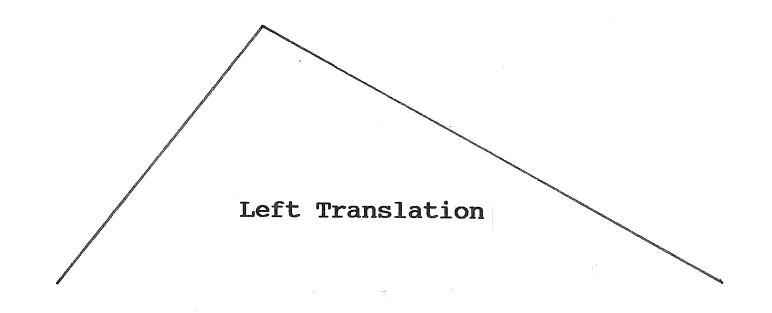
In a falling market, prices tend to go up for a shorter period of time than they go down. This is called Left Translation, and it can be restated that in a bear market the down-phase of the cycle will last longer than the up-phase.
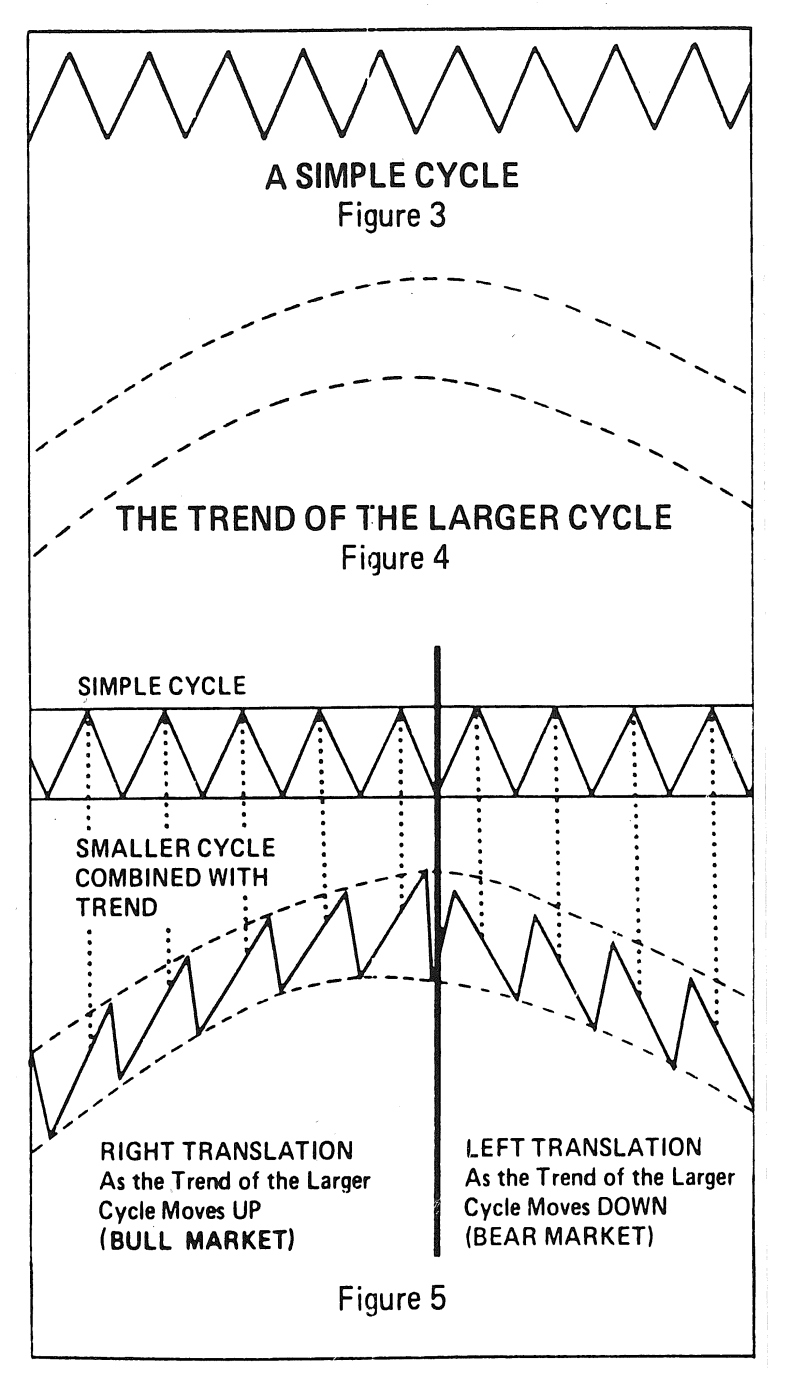
Dominant Cycles of different lengths interact in a predictable manner as each cycle is affected by the next larger cycle. The simple cycle in Fig. 3 moves up and down from crest-to-trough, and trough- to-crest in a predictable rhythm with each high equidistant to the lows. When combined with a larger cycle this rhythm changes, but in a predictable and consistent manner. In Fig. 4, the trend of the larger cycle is represented by the parallel dashed lines. Fig. 5 illustrates Right and Left Translation. As the market rises to the top of the larger cycle, the tops, or crests, of the smaller cycles shift to the right, exhibiting a cyclical characteristic called Right Translation (see dotted lines in Fig. 5). Also, the bottoms, or troughs, of the smaller cycle are above the previous troughs, and the crests are above the previous crests.
When the larger cycle is moving down, the crests of the smaller cycles shift to the left exhibiting Left Translation. Also, each trough is below the previous trough, and each crest is below the previous crest.